Heed AI Solutions / Case in point
Did the money make it to the bank?
Every store. Every day. Every payment type. For one 47 store retail group, answering that question by hand took most of the day, every day.
Heed AI Solutions / Case in point
Every store. Every day. Every payment type. For one 47 store retail group, answering that question by hand took most of the day, every day.
01 / The sources
Cash through an ATM. Card batches that bundle a whole weekend into Monday. A financing program that pays the entire company in one lump sum, net of fees that change by promotion. Nothing arrives on the same schedule.
02 / The nuance
Friday and Saturday settle on Monday. A batch that misses the nightly cutoff lands a day later. One location runs its own bank account under its own rules. Bank holidays move all of it.
03 / The real cost
Every morning, by hand, no matter what. Vacations needed a coverage plan, and month end stacked a thirty tab workbook on top. It is not a staffing situation. It is a single point of failure, and it wears down the people who hold everything together.
“It’s just copy and paste. Yeah.”
03 / The engine
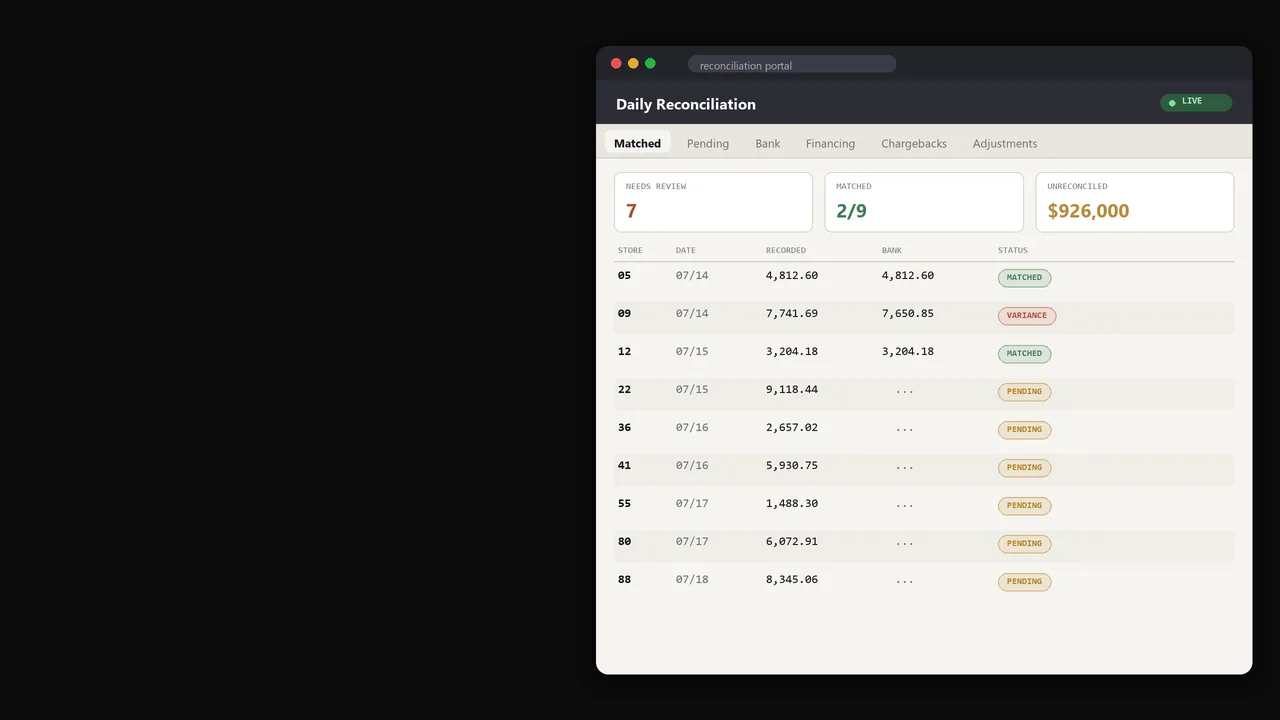
Every one of those rules, encoded. Each store, each day, each payment type matched against the bank on its true funding calendar. When a shortage cannot be explained with certainty, the tool says exactly that and hands it to a person.
04 / Every morning
The short list of stores where money is genuinely missing. Nothing else.
The road to a closed day
Six stops between the question every operator asks each morning and the short list that answers it.
Stop one / The question
It sounds like a question with a quick answer. It is not. The money left those stores as cash, on cards, and through a consumer financing program, and each of those travels a different road to the account, on a different timetable.
Stop two / Five sets of books
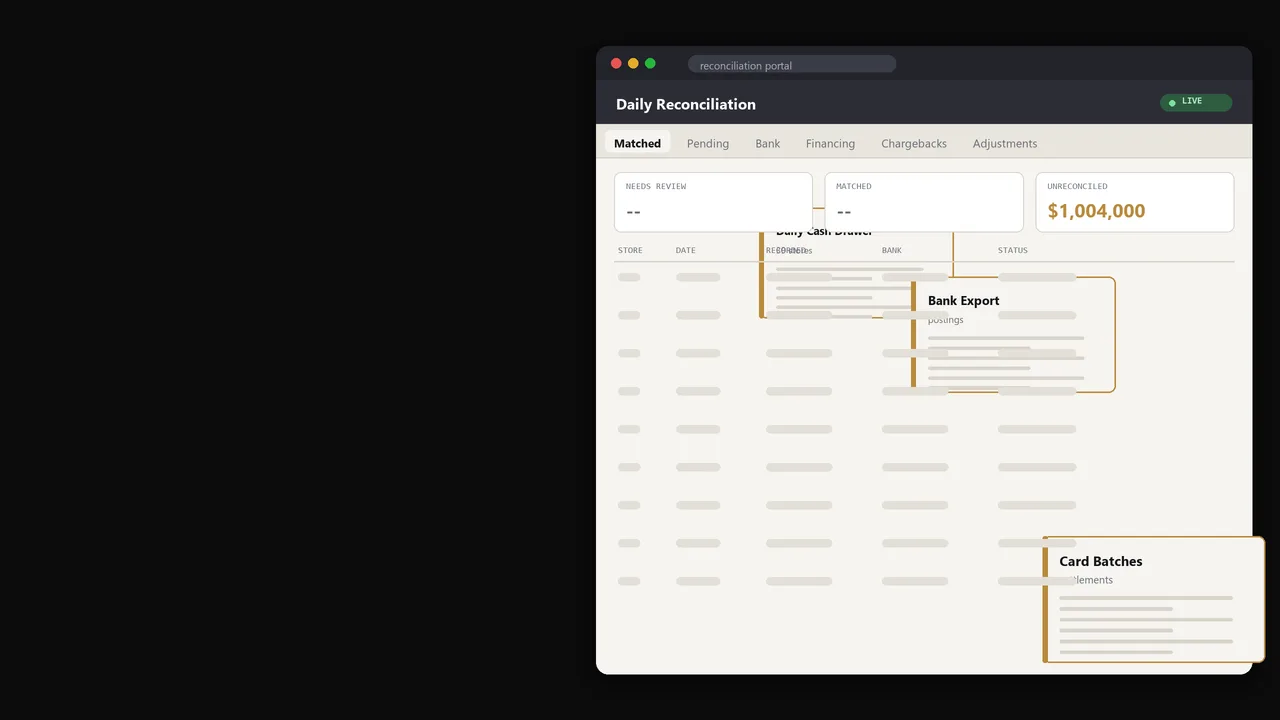
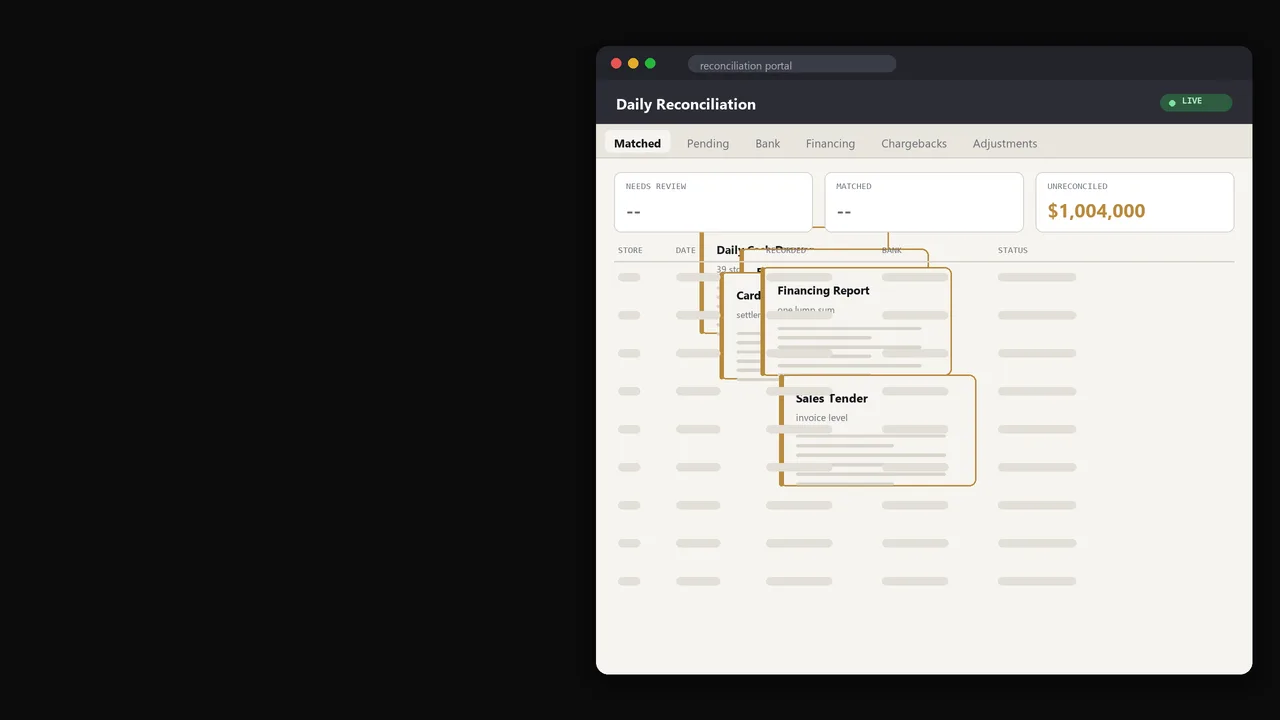
Daily cash drawer totals. Bank activity. Card batches. The financing report. Invoice level tender. Five files, five formats, five different clocks — and not one of them is wrong. They simply do not line up on the same day.
Stop three / The rules nobody wrote down
One location banks on its own. The financing program pays a single lump sum for everyone, net of fees. Holidays move all of it. These rules live in somebody's head, and they are the reason most mismatches are not mismatches at all.
Stop four / The bridge is a person
It takes hours, it is never quite finished, and it quietly makes one person the only one who understands how any of it works. When that person leaves, the knowledge leaves with them.
Stop five / The engine
Every store, every day, matched against the bank on its real funding calendar. Exact math and stated rules — and never a guess. When a row cannot be explained honestly, it says so plainly instead of inventing an answer.
Stop six / The short list
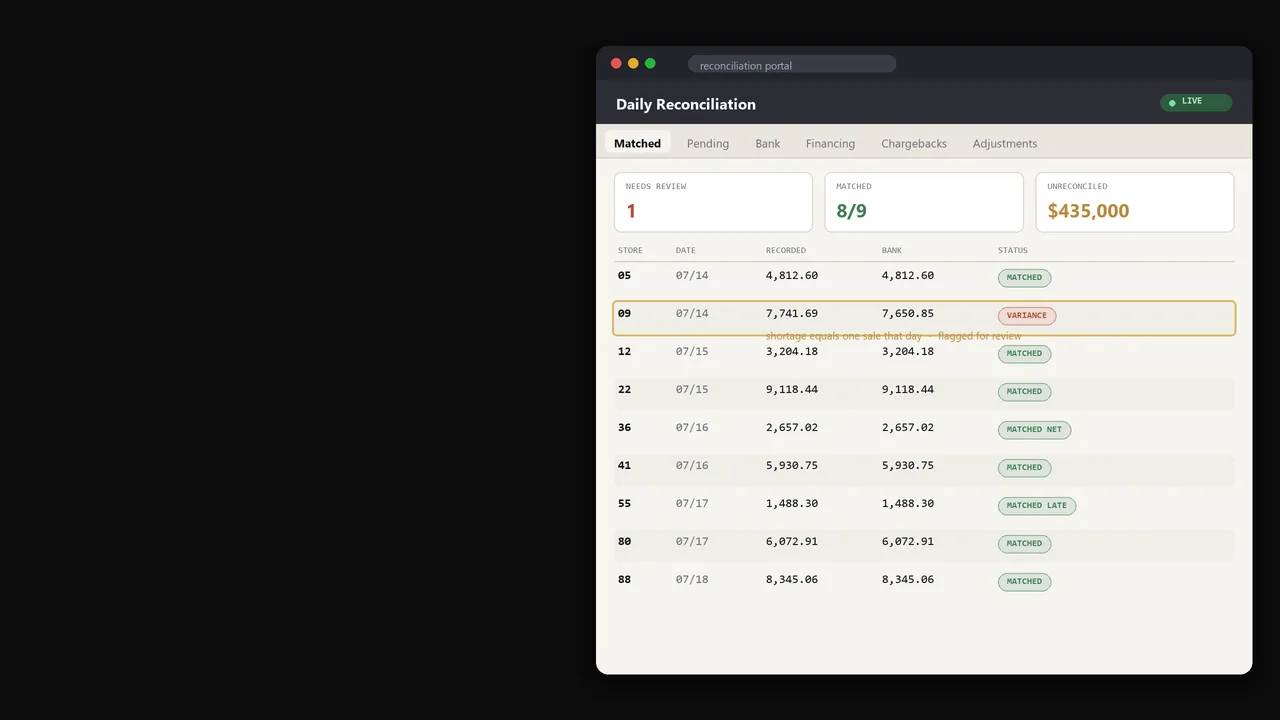
Each unmatched row arrives with its reason attached and, wherever the record allows, pinned to the exact sale behind it. Items escalate on their own at day three and day five, so nothing needs chasing and nothing quietly ages.
Before the second cup of coffee the day is closed, the exceptions are named, and the person who used to carry all of it has their morning back.
Map your reconciliationBuilt alongside the accounting team that does the work. Their rules became the engine, session by session, screenshot by screenshot. More than forty releases shipped in two weeks.
Matched to the bank on a realistic window of banking days, with a grace amount, branch depositor handling, and each store's quirks encoded. Sundays and bank holidays are excluded from the count automatically.
Matched on their true funding calendar. Weekend bundles, nightly cutoff splits, late funders and next day netting are all handled automatically and explained in plain English on the row itself.
One company lump sum decomposed into per store expectations with exact fee math, then cross checked against the processor's own daily report, which predicts the bank credit to the penny one banking day out.
A shortage gets pinned to the single invoice that caused it, so the store makes one phone call. A sale rung on the wrong payment type gets flagged with the matching offset suggested. Two processor funding shortfalls, $607.58 and $862.19, were caught to the penny and documented.
Link, offset, write off, unpair, correct a source number. Every action records who did it and when, and every action can be undone. Month end write offs become a clean printable report instead of archaeology.
Items that sit unresolved move up on their own, to the team at day three and to leadership at day five. The company president sees exactly one thing: the stores where money is genuinely missing.
Outsourced accounting firms, fractional CFO practices and bookkeeping shops hit the same wall, only multiplied by every client on the roster. There are two ways to work with us.
Bring the engine to the client books you already close. One reconciliation method across every client, instead of a different spreadsheet per engagement.
You already know which clients are drowning in manual reconciliation. We build the engine, you keep the relationship and the advisory work that sits on top of clean numbers.
Tell us how the money moves in your business and we will tell you where the blind spots are. No software to install and nothing to rip out.
Prefer the longer version first? Read the full case study, or the page written for CFOs and owners, controllers, or the person who carries it every day.
No. The engine sits on top of the systems you already own, including a point of sale from another era and an accounting server that predates the cloud. Nothing is ripped out and nothing is installed on your machines. In this build the entire thing ran behind zero trust access for a company with no in house IT team.
The matching is deterministic. It is exact math against written rules that your team defines, so the numbers are never a model's guess. AI is why the tool could be built and refined this quickly, and it powers the assistant that answers plain English questions about your data. Every judgment call stays with a person.
It says so. Unexplained items are never quietly matched or absorbed. They go into a review list with whatever evidence exists, including the nearest candidate deposits and, where the data supports it, the exact invoice that accounts for the difference. A person decides, and the decision is recorded with their name and the time.
In this engagement the kickoff working session was on a Tuesday and the team logged into a live secured dashboard the next day. Working software comes first and the rules get encoded with your team from there. More than forty numbered releases shipped in the following two weeks, most of them the same day they were requested.
The math is the same at two locations as it is at forty seven. The question is whether someone on your team is spending a meaningful part of every morning answering it by hand, and whether the rules for doing so live only in that person's head. If both are true, the size of the company is not really the issue.